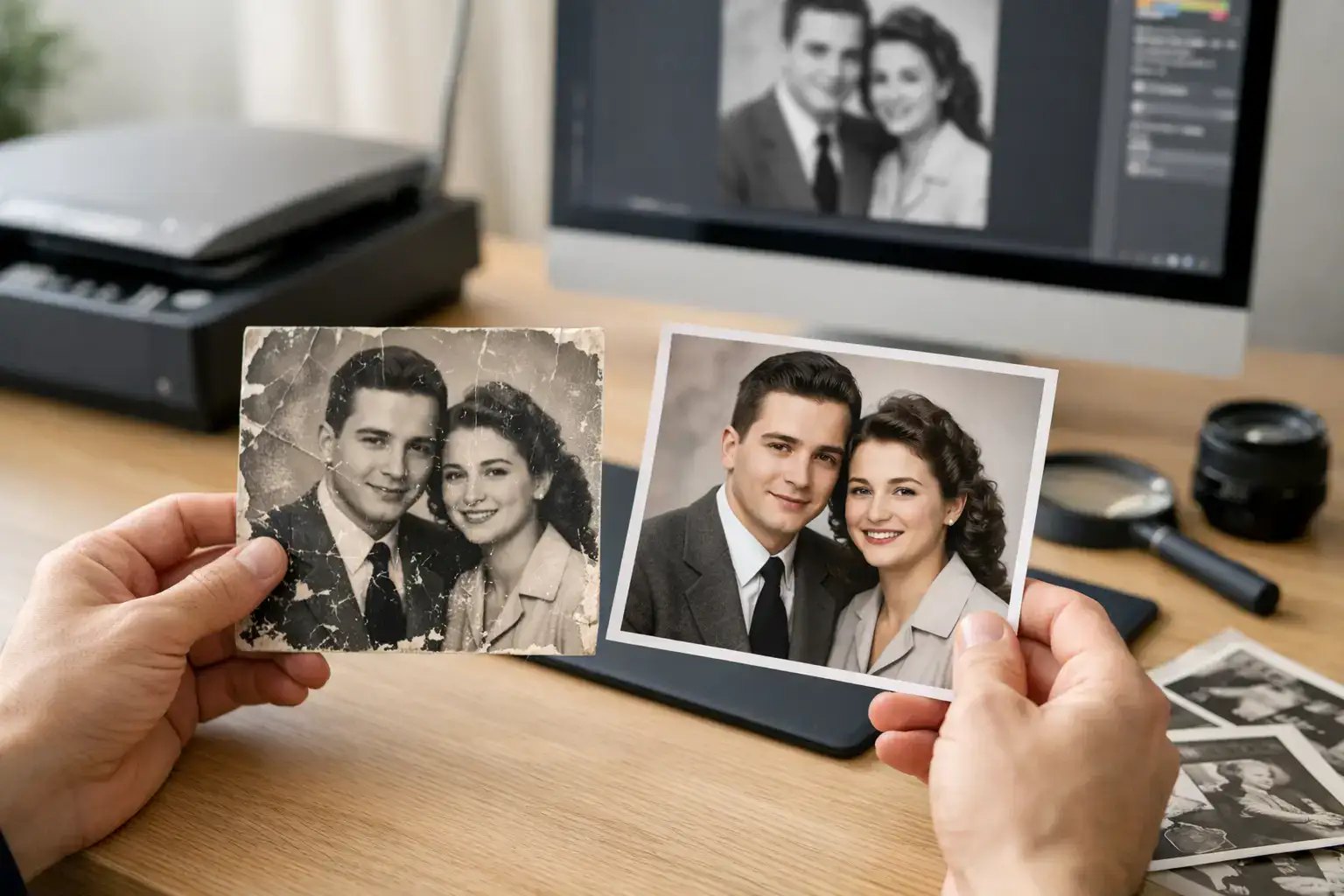
There is something quietly powerful about holding an old photograph in your hands. A wedding portrait with cracked edges, a faded family snapshot from a summer long gone, a picture of grandparents as young parents – these are not just bits of paper. They are part of your story. That is why getting old photos restored can feel far bigger than a simple edit. It is about keeping people, places and moments close, even as time does its best to wear them away.
For many families, these photographs sit in drawers, biscuit tins or old albums in the loft, waiting for the right moment. Often, that moment comes when someone is planning a wedding slideshow, creating a memory table, putting together a family album or simply realising that the only image of a loved one is starting to fade beyond recognition. Restoration gives those pictures a second life, but it needs to be done with care.
Why getting old photos restored matters
A restored photograph is not about making the past look brand new. It is about preserving what matters without stripping away the character of the original image. Scratches can be softened, tears repaired and fading corrected, but the heart of the photograph should still feel true to the time it came from.
That balance matters more than people often realise. If a restoration is too heavy-handed, faces begin to look artificial, skin turns waxy and details that were never there get invented. If it is too light, the damage still distracts from the memory. Good restoration sits in the middle. It respects the original while carefully improving what time has taken.
For families, that can be deeply emotional. A restored image can become the version that finally gets framed, printed in an album or shared with the next generation. Instead of being hidden away because it is too damaged or fragile, it becomes something you can actually live with and enjoy.
What can usually be repaired
Most old photographs have a mix of physical and visual damage. Creases, small tears, dust marks, faded contrast and yellowing are all common, especially in prints that have been handled often or stored poorly. In many cases, these issues can be improved significantly through careful scanning and digital retouching.
Water damage is more complicated. Sometimes the staining can be reduced enough to make the image feel whole again. Sometimes parts of the photograph have been lost completely, and restoration becomes a blend of repair and interpretation. The same is true for severe mould damage or sections that have stuck to album pages and torn away.
Black and white images often restore beautifully because the tones can be rebuilt with subtlety. Colour photographs can also be brought back to life, but colour shifts are trickier. Reds may have disappeared, skin tones may have turned odd, and the paper itself may have changed over time. Restoring that naturally takes patience and a good eye.
The difference between restoration and over-editing
This is where experience really counts. Anyone with editing software can remove a scratch. Restoring an old family photograph properly is something else. It requires judgement. You need to know when to leave a little texture in place, when to rebuild missing detail, and when a photograph should still look like it belongs to its era.
That is especially important with portraits. A face holds so much emotional weight. If an image of a parent, grandparent or child is retouched too aggressively, it can stop feeling like them. The goal is not perfection. The goal is recognition, warmth and honesty.
There is also a practical side to this. Some clients want a restoration that stays faithful to the original print, blemishes and all, just cleaner and more stable. Others want a version suitable for enlarging and displaying in the home. Neither approach is wrong. It simply depends on what the photograph means to you and how you want to use it.
How the restoration process usually works
The first step is creating the best possible digital copy. That often means a high-resolution scan rather than a quick phone snap. A proper scan captures more detail in shadows, highlights and surface texture, which gives far more room for careful repair.
Once digitised, the image can be worked on in stages. Dust and scratches are removed first, then larger tears, missing corners or crease lines. After that, tones and contrast are adjusted so the picture feels balanced again. If needed, colour can be corrected, though this is usually done gently rather than pushed too far.
Some photographs need reconstruction in tiny areas, such as rebuilding part of a sleeve, smoothing a cracked forehead or restoring the edge of a bouquet. This is where restoration becomes meticulous work rather than a quick fix. The smallest changes can make the biggest difference, especially in expressions and hands.
When the work is finished, the restored image should be saved carefully and prepared for whatever comes next. That might be a digital file for safekeeping, a new print, or a place in an album alongside more recent family photographs.
Should you restore and print, or keep it digital?
Digital copies matter, of course. They protect the image from further handling and make it easier to share with family. But there is something special about seeing a restored photograph properly printed. Old memories deserve more than being left on a hard drive.
A good print gives the image presence again. It can take a damaged, forgotten photograph and turn it into something worthy of a frame on the wall or a page in a keepsake album. For weddings and family celebrations, restored images can also add a lovely thread between generations – grandparents on their wedding day beside a couple starting their own story, for example.
This is one of those moments where quality really does matter. A beautifully restored image deserves a print finish that feels timeless rather than disposable. Cheap printing can flatten tones, exaggerate flaws and lose the subtle detail that careful restoration worked to preserve.
What to look for when getting old photos restored
Trust is a big part of this process. You are not handing over just any image. You are handing over a piece of family history. That means the person restoring it should understand both the technical side and the emotional weight behind it.
Look for someone who values natural results. Their work should feel respectful, not flashy. It should still look like an old photograph, just one that has been given proper care. Ask how they approach missing details, whether they can prepare files for print, and how they handle fragile originals.
It is also worth being clear about expectations from the start. Some photographs can be transformed. Others can only be improved to a point. A good professional will be honest about that. Sometimes the most meaningful result is not a perfect image, but one that feels viewable, recognisable and safe for the future.
If you already value printed photographs, albums and artwork in your home, restoration fits naturally into that same way of thinking. It is part of preserving your story, not just storing it. Graeme Webb Photography understands that lasting images are about more than the moment they were taken. They become part of what a family carries forward.
Caring for original photographs after restoration
Even if you have a restored digital copy, it is still worth looking after the original print. Store photographs somewhere cool and dry, away from direct sunlight and damp. Avoid lofts and garages if you can, as temperature swings and moisture can do real damage over time.
If a print is particularly delicate, handle it as little as possible and keep it in archival storage rather than ordinary envelopes or plastic sleeves. And if you are sorting through old albums, go gently. Pages that seem stuck can tear a photograph in seconds.
The restoration may give the image new life, but careful storage helps ensure the original survives too. That matters, even if you never plan to display it again.
When restoration is especially meaningful
Often, the photographs people want restored are the ones tied to change. A parent who has passed away. A childhood home that no longer stands. A wedding portrait from a marriage that shaped the whole family. These pictures carry weight because they connect generations.
That is why restoration can be such a thoughtful gift as well. Not flashy, not impersonal, but deeply felt. A restored portrait presented as a print or added to an album can mean far more than something bought in haste. It says this memory matters, and it deserves to be seen.
If you have photographs tucked away that are becoming harder to recognise each year, this may be the right time to act. Paper fades. Corners curl. Damage rarely stops on its own. But with the right care, even a worn and fragile image can become something beautifully lasting again.
Some memories arrive in crisp detail, and some need a little help returning. There is no shame in that. The important thing is giving them the chance to be held, shared and remembered properly.