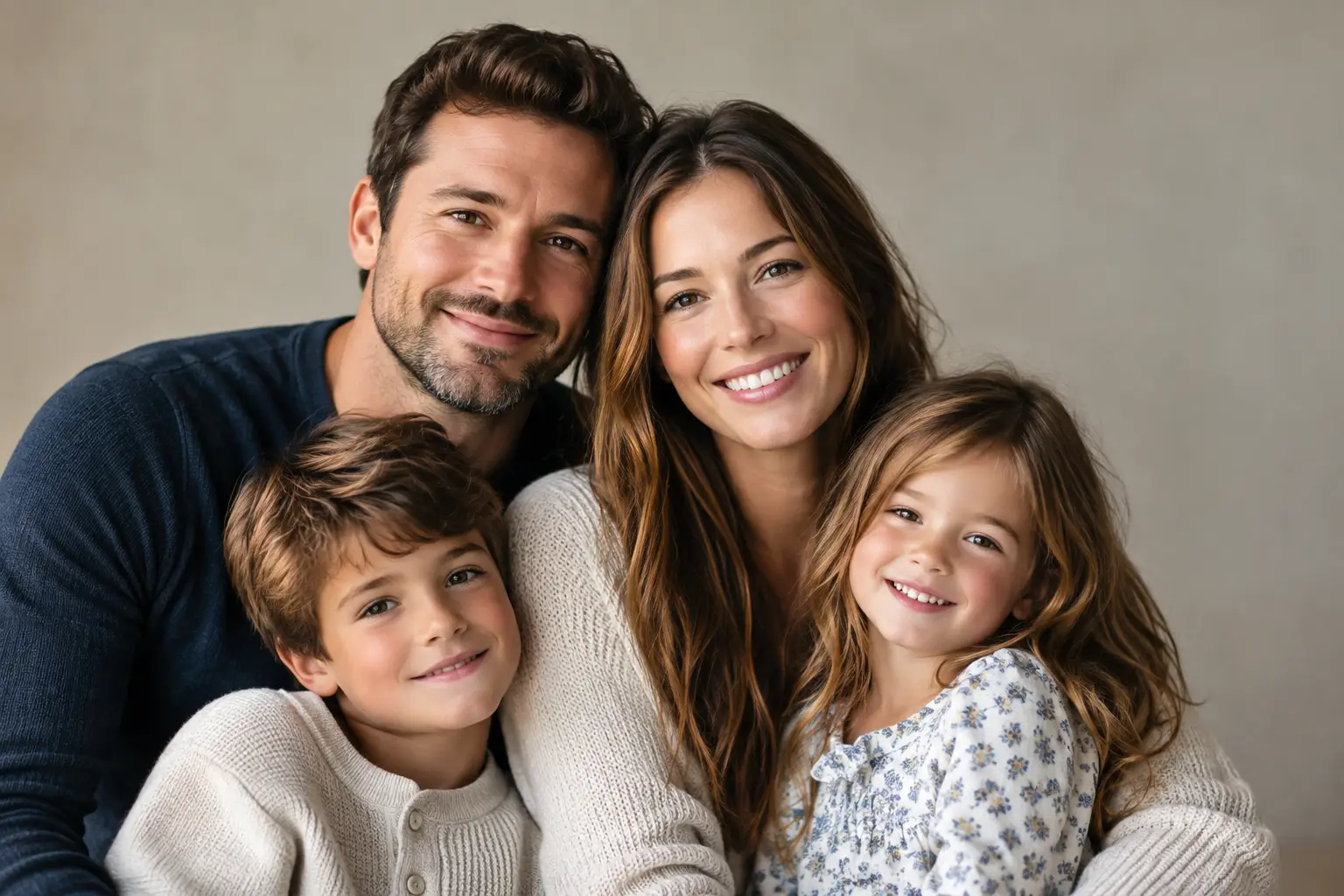
A child’s hand tucked into yours. The way your dog watches you before a walk. Two people who are usually far more comfortable making each other laugh than standing in front of a camera. Fine art portraits are not about asking you to perform a version of family life that does not feel like yours. They are about noticing the connection that is already there, then preserving it with care.
The most meaningful portraits rarely come from a perfect pose. They come from a small glance, an unguarded smile, a reassuring arm around a shoulder. Years from now, those are often the details that bring you straight back to how this chapter of life felt.
What makes a portrait fine art?
Fine-art portrait photography brings together thoughtful composition, flattering natural light and a considered approach to the finished image. It has an artistic quality, but it should never feel cold, overly stylised or disconnected from the people in the frame.
For families, couples and pet owners, that means photographs with room to breathe. The setting, light and colours are chosen with intention, while the people remain the heart of the image. A portrait might be beautifully composed, but it still needs to look and feel like you.
There is a balance to strike. Too much direction can make expressions feel fixed. Too little can leave people feeling uncertain, particularly if they have arrived convinced they are awkward in photographs. Gentle guidance gives everyone something simple to do, then leaves space for the real moments to appear.
That approach is especially valuable with children. They do not need to sit perfectly still or smile on demand for every photograph to work. A quiet cuddle, a game, a race along a path or a moment of curiosity can say much more about their personality than a formal pose ever could.
Fine art portraits should feel lived in, not staged
A relaxed session is not a session without a plan. It is one where the plan is built around your people rather than forcing your people into a plan.
Before a shoot, it helps to think about what you would like to remember. Perhaps your toddler’s determined little character is the whole point. Perhaps your children are growing quickly and you want a photograph where everyone is together, without the familiar chaos of trying to take one yourself. For a couple, it may be the ordinary ease between you that deserves to be seen. With pets, it is often the small quirks that make them unmistakably theirs.
These details shape the session more than a list of poses. A location with room for children to explore may be better than a dramatic setting that leaves everyone worried about muddy shoes. A session at home can be deeply personal, especially during early family life, while an outdoor location in the Scottish Borders can bring a sense of freedom and changing seasons. Neither choice is automatically better. The right one is the place where you can settle and be yourselves.
For those planning a wedding, portrait time works best in much the same way. It should offer a few calm minutes together, rather than feeling like an interruption to the celebration. The photographs can be elegant and beautifully lit while still holding the warmth, laughter and closeness of the day.
The comfort behind natural expression
Many people begin a portrait session with the same concern: “We are not very good in front of the camera.” The good news is that you do not need to be.
A thoughtful photographer will not leave you wondering where to put your hands, but nor should they keep you pinned in one position. Small prompts create natural movement: walking together, looking at one another, sharing a joke, cuddling in close. The camera is there, but it does not need to take over.
Children and pets are particularly good at reminding us why flexibility matters. A child may need a break, a snack or a chance to investigate a puddle. A dog may decide that a stick is suddenly the most important thing in the world. Working with those moments, rather than against them, often creates the photographs with the most life.
You do not need matching outfits or a complicated styling plan either. Clothes that feel comfortable and work gently together tend to photograph best. Soft, complementary tones usually keep attention on faces and connection, while clothes without large logos or very busy patterns can help the finished images feel timeless. Above all, choose something that still feels like you.
Light, location and the quieter details
Beautiful portraiture depends on light, but beautiful light does not always mean bright sunshine. In fact, soft overcast conditions can be wonderfully flattering, bringing an even, gentle quality to skin tones. Early morning or later afternoon often gives a warmer feel, while a bright day may call for open shade and a carefully chosen backdrop.
Scotland’s changeable weather is not always a drawback. Wind can add movement to a dress or hair. Cloud can bring mood and texture to a landscape. A little drizzle may make an outdoor session impractical in some circumstances, but it can also pass quickly. The key is having a calm, sensible plan and keeping the experience enjoyable rather than chasing a picture at all costs.
Location should support the story rather than compete with it. A favourite woodland walk, a garden that has seen years of family life, a peaceful stretch of coastline or a simple neutral space can all work beautifully. Grand scenery is lovely, but it is not essential. Connection remains the main subject.
From digital files to artwork that belongs at home
Photographs deserve more than a brief appearance on a phone screen. Digital images are valuable, of course, and it is reassuring to have them safely stored. Yet the images that become part of everyday family life are often the ones you can see.
A framed portrait in the hallway becomes a familiar part of home. An album gives children something to return to and lets grandparents linger over moments they may otherwise only hear about. A carefully chosen print can turn a passing season into a physical reminder of who you were together.
This is where a fine-art approach extends beyond the session itself. The image needs to work as a finished piece: considered in its composition, colour and feeling, and made to sit naturally within your home. Not every photograph needs to become wall art. Choosing one or two that carry real emotional weight is often more powerful than trying to display everything.
At Graeme Webb Photography, that long-term value matters. The aim is not simply to provide a gallery and move on, but to create photographs and heirloom pieces that feel personal now and grow more meaningful with time.
Choosing the right time for a portrait session
There is rarely a perfect moment. Children will not suddenly become less busy, dogs will not become less enthusiastic and family diaries will always seem full. But there are seasons that feel worth marking: a new baby, a birthday, an anniversary, a family reunion or simply the fact that everyone is together.
If you are booking around a milestone, allow a little breathing room where possible. Newborn and young-family life can be unpredictable, and an unhurried approach makes a genuine difference. For outdoor sessions, consider the look and feel you love as much as convenience. Spring brings fresh greens, autumn brings warmth and texture, and winter light can be beautifully soft when everyone is wrapped up and close.
The best time, though, is often when you realise you want to remember this version of your life before it changes. Bring the people you love, let the session unfold at its own pace, and make space for a photograph that will still feel like home many years from now.