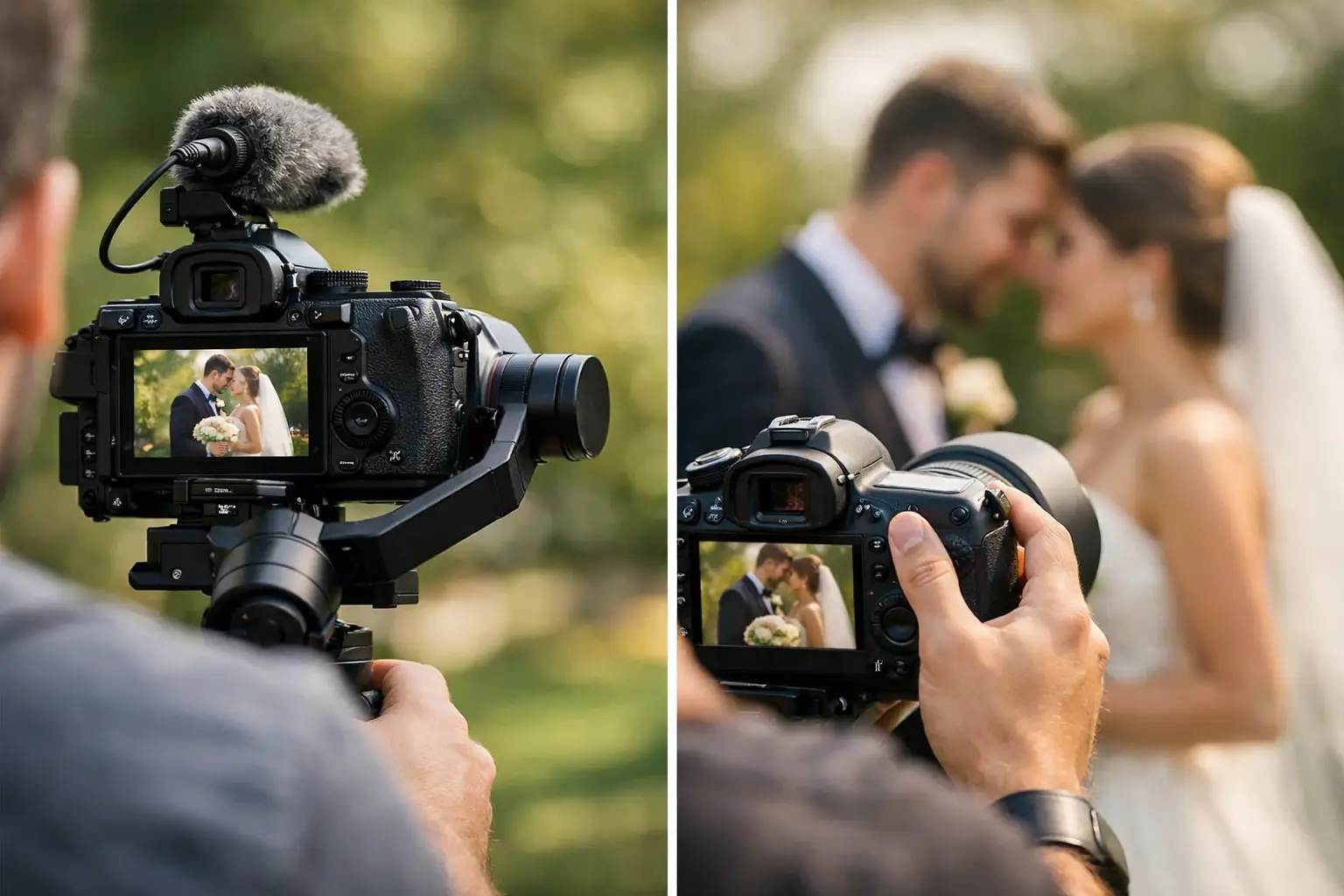
Your wedding day will move more quickly than you expect. One minute you are fastening a button, taking a breath before the ceremony or greeting your favourite people, and the next you are being called through for dinner. When couples weigh up wedding videography versus photography, they are rarely asking which is better. They are deciding how they want to return to the feeling of a day that passes in a beautiful blur.
Both can tell your story brilliantly. Both ask for space in the budget. And both offer something the other cannot quite replicate. The right choice depends on what matters most to you, how you imagine revisiting the day, and whether you would rather hold a moment still or hear it unfold again.
Wedding videography versus photography: the real difference
Photography gives you a single, carefully observed moment. A photograph can hold the squeeze of a hand during the ceremony, your dad seeing you ready for the first time, or the laughter that arrives halfway through a speech. It asks you to pause, look and remember what was happening around that instant.
Video brings movement and sound into the memory. You can hear the crack in a voice during vows, the cheers as you walk back down the aisle, the music that filled the first dance and the exact words that made everyone laugh. For many couples, hearing loved ones speak becomes even more meaningful with time.
Neither medium is more emotional by default. They simply carry emotion differently. A film can place you back in the atmosphere of the day. A photograph can become a quiet, lasting reminder that catches you unexpectedly as you walk past it every morning.
What photographs do especially well
A wedding photographer notices the small visual stories that make a day yours: a hand-written note, a grandparent watching from the side, rain catching the light outside the venue, or your friends in fits of laughter on the dance floor. These moments can be preserved without turning the day into a production.
Photography is also wonderfully suited to print. A fine-art album lets your story unfold slowly, page by page. A framed portrait on the wall becomes part of family life rather than something waiting to be opened on a screen. Years from now, your children and grandchildren can turn those pages and see the people, places and expressions that shaped the day.
For couples who feel uneasy in front of a camera, relaxed photography can be particularly reassuring. Most of the day can be documented naturally, with gentle direction only when it helps. You do not need to perform your wedding. You just need to be present in it.
What video does especially well
A wedding film has a sense of immediacy that is difficult to match. The pace of your walk down the aisle, the way you laugh together, the sound of your guests singing badly but enthusiastically at the end of the night – these are things still images cannot play back.
Video can be especially valuable if the spoken parts of the day matter deeply to you. Personal vows, readings, speeches and messages from relatives are all full of personality. If a loved one is unable to attend, or if having their voice recorded feels especially precious, videography may carry real weight.
That said, a film is usually experienced as a whole. You set aside time to watch it, perhaps on an anniversary or a quiet evening. It can be a powerful experience, but it does not have the same everyday presence as a print above the mantelpiece or an album left on the coffee table.
Which will you return to more often?
This is one of the most useful questions to ask yourselves. Think beyond the weeks after the wedding, when everything still feels fresh.
Photographs often become part of the fabric of your home. A framed image can make you stop for a second on a difficult Tuesday. An album can come out when friends visit, at Christmas, or when you want to show someone what your celebration felt like. Still images are easy to revisit in small moments, and the best ones reveal something new each time.
Films tend to create a more immersive return. You may not watch one every week, but when you do, you can be transported. The decision is not about frequency alone. It is about whether you value a collection of meaningful fragments you can live with daily, or the chance to sit down and relive the rhythm and sound of the occasion.
Many couples choose both because they do not want to choose between those experiences. If your budget allows, photography and videography can complement each other beautifully. The key is to book professionals whose approach feels compatible, particularly if you want an unhurried, natural day rather than constant direction from several cameras.
Think about your wedding day, not just the finished result
Your supplier team shapes the experience as well as the keepsakes. This matters a great deal when deciding between wedding videography and photography.
A photographer may work quietly through much of the day, stepping in to create a handful of natural portraits and group photographs while leaving room for you to spend time with your guests. A videographer may need to consider sound recording, camera placement and movement through the ceremony space. None of this is a problem with an experienced professional, but it is worth discussing upfront.
If you are marrying in the Scottish Borders, Edinburgh, the Lothians or Northumberland, practical details can matter too. A blustery hilltop, a dark winter afternoon, a compact ceremony room or a lively ceilidh all call for thoughtful planning. Ask how each person works in changeable weather, low light and busy spaces. Their answer should leave you feeling calmer, not more managed.
It is also sensible to ask whether they have worked together before, or how they will coordinate if you book separate suppliers. Great collaboration means no one competes for your attention, and you are free to enjoy the people you invited.
Budget: where should you place the priority?
There is no universal split, and you should not feel pressured to stretch beyond what is comfortable. Start by protecting the parts of the day that feel non-negotiable to you. For some couples, hearing their vows again is priceless. For others, a beautifully made album is the heirloom they have always imagined.
Photography often includes more individual finished images, while videography may involve substantial editing time to craft a highlights film and longer ceremony or speech edits. Compare what is actually included rather than looking at one headline price. Ask about coverage hours, delivery format, editing style, albums or prints, audio recording, travel, and whether there are any additional costs to consider.
If you can only choose one, choose the medium that you feel a genuine pull towards, not the one social media tells you that you ought to have. A considered photography collection is more valuable than a rushed attempt to have everything. The same is true of a film created by someone whose work and presence you trust.
When photography may be the better fit
Photography may be the stronger choice if you are drawn to tangible artwork, want a relaxed documentary feel, or know you will treasure portraits of the people who shared the day. It is also a lovely fit if you value small, expressive moments as much as the headline events.
For many couples, the album becomes the centrepiece. It preserves the full story with intention: the anticipation, the ceremony, the hugs, the speeches, the wild dance floor and the quiet just-married moments in between. At Graeme Webb Photography, that belief in photographs as lasting, physical keepsakes sits at the heart of the experience.
When videography may be the better fit
Videography may be your priority if voices, music and movement are at the centre of how you remember people. It can be particularly meaningful for emotional vows, family speeches or celebrations where the energy of the room is a huge part of the story.
A film can also suit couples who know they will enjoy sharing the day with relatives who could not be there. Just be realistic about what you want from it. A short highlights film, a feature-length edit and full recordings of the ceremony and speeches offer very different experiences.
A choice worth making together
Sit down for a wee chat without a spreadsheet open at first. Talk about the moments you are most looking forward to, the people you most want to remember, and how you hope to feel when you look back in ten or twenty years. Your answers will usually make the decision clearer.
Whatever you choose, choose people who help you feel like yourselves. The finest record of a wedding is not the most posed, polished or elaborate one. It is the one that lets you recognise the warmth, nerves, laughter and love that were truly there.