If you are trying to build a wedding first look timeline, the real question usually is not “What time should we do it?” It is “How do we make space for one of the most meaningful parts of the day without feeling rushed, over-managed or late for everything else?” That is where good planning makes all the difference.
A first look can be one of the calmest moments in the whole wedding day. Before the ceremony, before the hugs from every direction, before the schedule starts pulling at your sleeves, you get a few minutes together. Done well, it gives you breathing room, beautiful photographs and a gentler start to the day. Done badly, it can feel squeezed in between hairspray and buttonholes.
Why the wedding first look timeline matters
A first look is not simply another photo slot. It affects the shape of the day. If you see each other before the ceremony, you can often take a good portion of your couple portraits and even some wedding party photographs earlier on. That means less time away from guests later and a more relaxed flow after the ceremony.
It also changes the emotional rhythm. Some couples love the anticipation of waiting until the aisle. Others know they will feel steadier, more present and more connected if they have a private moment first. Neither is more romantic than the other. It depends on your personalities, your ceremony time, the season and how much you want your photography woven into the day rather than bolted on around the edges.
From a photographer’s point of view, timing matters because a first look needs a little more than the reveal itself. You need time to arrive separately, settle nerves, let the moment happen naturally and then move into a few relaxed portraits while the emotion is still fresh. If every minute is accounted for too tightly, the atmosphere changes.
How much time to allow in your wedding first look timeline
For most couples, I would allow around 30 minutes for the first look itself and another 20 to 40 minutes for portraits afterwards, depending on what else you want photographed before the ceremony. That does not mean all of it is spent posing. In fact, the best images usually come from giving the moment enough room to breathe.
As a rough guide, getting to the location and set-up can take 10 minutes. The actual first look might be only a few minutes long, but those few minutes are worth protecting. After that, 20 to 30 minutes for couple portraits often works beautifully if the light and location are close by.
If you also want wedding party photographs before the ceremony, add another 20 to 30 minutes. If family formals are happening beforehand as well, the timeline needs more care because family combinations are often the part that takes longest to organise.
What matters most is not cramming everything into a neat-looking spreadsheet. It is making sure no key moment begins with someone saying, “Right, we’ve only got five minutes.”
A sample wedding first look timeline
Every wedding is different, but here is a realistic shape for a ceremony at 2pm.
Hair and make-up would ideally be finished by 12 noon for the person getting ready first, not at 12.30 when everyone is suddenly hunting for earrings. Getting into the dress or suit, final touch-ups and a few quiet preparation photographs could then happen between 12 and 12.30.
Travel to the first look location might be around 12.30 to 12.45, depending on the venue. The first look itself could happen at 12.45, with couple portraits from 12.50 to 1.20. If the wedding party is organised and ready, a few group photographs might follow from 1.20 to 1.40. That still leaves a small buffer before the ceremony, which is often the difference between calm and chaos.
The buffer is the bit couples are most tempted to cut, and it is nearly always the bit that saves the day. Cars run late. Someone cannot find cufflinks. A registrar needs a quick word. Without a little slack in the schedule, one delay starts tugging everything else out of place.
When a first look works best
A first look suits couples who value a quieter, more private reaction. If you are not especially comfortable being the centre of attention, this can be a lovely way to have an emotional moment without a room full of people watching. It also helps if you want to enjoy more of your drinks reception rather than disappearing for most of it.
It can be especially useful for winter weddings in Scotland and the north of England, when daylight is limited. A December ceremony at 3pm leaves very little natural light afterwards. In that case, a first look before the ceremony can protect time for portraits while there is still daylight to work with.
It is also practical if your ceremony and reception are in one place and the venue grounds are part of what drew you there. If the gardens, woodland, courtyard or nearby landscape matter to you, using some of that space before guests arrive can be a very gentle way to build those photographs into the day.
When it might not be the right choice
Not every wedding needs a first look. Some couples have dreamt for years about seeing each other for the first time at the ceremony, and that feeling should not be talked away for the sake of efficiency. If the aisle moment is central to how you imagine the day, honour that.
There are practical reasons too. If your schedule is already tight because of separate travel, a late ceremony or cultural traditions that shape the day, forcing in a first look can create more pressure than it removes. The whole point is to make the day feel easier, not more managed.
There is also the question of emotional energy. Some couples find that a first look settles nerves beautifully. Others feel they would get teary twice and would rather keep all that emotion for one moment. Again, it depends.
Choosing the right location and light
The best first look locations are usually simple, quiet and easy to reach. Privacy matters more than grandeur. A tucked-away garden path, a sheltered courtyard, a tree-lined lane or a peaceful room with good window light can all work beautifully. What you want is enough space for the moment to unfold naturally without guests wandering through the background or suppliers setting up beside you.
Light matters too, though not in a fussy or technical way. Harsh midday sun can be less flattering and less comfortable than open shade, while very dark interiors may need more planning. This is one of the reasons a venue walk-through or a proper conversation with your photographer helps. A good location is not just attractive. It supports the mood.
For couples marrying in the Borders, Edinburgh, the Lothians or Northumberland, the weather is always part of the conversation. A solid plan B is essential. That does not mean settling for second best. Some of the most atmospheric first looks happen under stone archways, inside bright entrance halls or near large windows with soft Scottish light pouring in.
Keeping it natural on the day
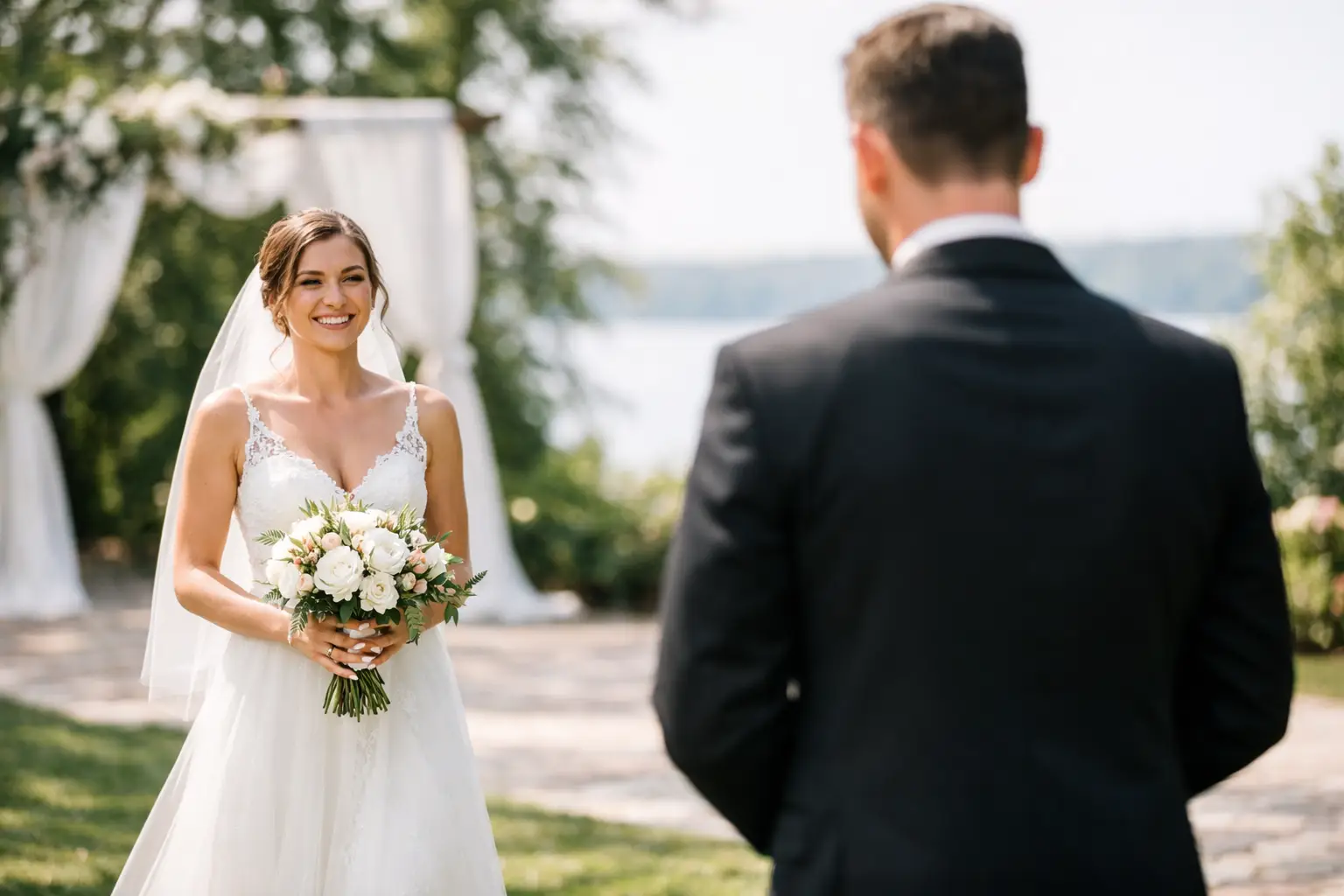
The loveliest first looks do not feel staged, even though they are planned. That balance comes from gentle direction rather than over-choreographing every step. Usually, one person is positioned first, the other approaches, and then everyone steps back and lets the moment happen.
You do not need to perform. You do not need to spin round on command or repeat the reaction because someone missed it. Just take your time. Speak to each other. Hold hands. Laugh if you laugh. Cry if you cry. The photographs will be stronger when the moment belongs to you rather than the timeline.
This is also where experience matters. A calm photographer helps protect the atmosphere, keeps things moving quietly and knows when to guide and when to disappear into the background. That kind of support is often what makes the whole experience feel easy.
Building a timeline that still feels like your wedding
The strongest wedding first look timeline is one that serves the day rather than controls it. Start with your ceremony time, then work backwards from there. Think about travel, getting ready, who needs to be where, and how much portrait time actually matters to you. Be honest about your pace. If you are both laid-back and hate rushing, build in more breathing room than you think you need.
It helps to think in terms of experience, not just timings. Do you want a quiet pocket together before everything begins? Do you want to join your drinks reception properly? Are winter daylight hours a factor? Do you want family photographs done earlier, or would that feel too busy before the ceremony?
There is no gold-standard schedule that suits everyone. The right timeline is the one that protects the feeling of the day while still allowing space for beautiful photographs. If that means a first look, wonderful. If it does not, that is just as valid.
A wedding day always moves faster than expected. The best timelines are not the ones packed most tightly, but the ones that leave room for real moments to happen.