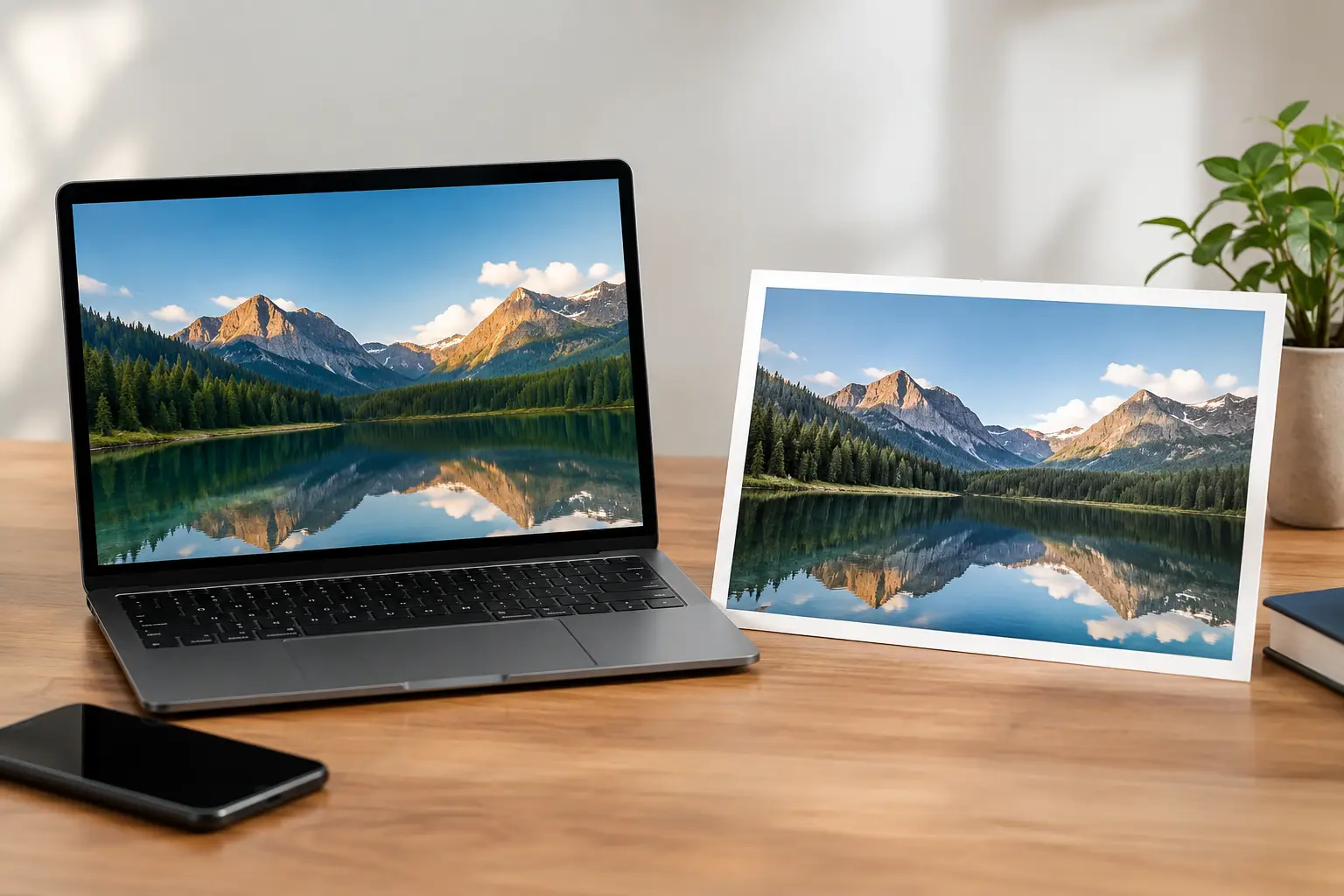
Your wedding photographs should not become a forgotten folder on a laptop. The conversation around digital files versus printed artwork is not really about choosing one over the other. It is about deciding how you want the moments that matter most to live alongside you in the years ahead.
A digital gallery brings immediacy, choice and the pleasure of being able to revisit your photographs wherever you are. A beautifully made album or framed print gives those same photographs a physical place in family life. Both have value, but they create very different experiences.
What digital files do brilliantly
Digital photographs are wonderfully practical. After a wedding, family session or pet portrait shoot, it is lovely to be able to share the excitement with the people who could not be there. A few taps can send a favourite image to a grandparent, add a photograph to a mobile phone background, or let a couple relive the laughter of their speeches on a quiet evening away.
For families, digital files are also a useful record of a changing season of life. Children grow quickly, pets do not stay puppies for long, and the everyday expressions you thought you would always remember can become surprisingly precious. Having a full collection means you can return to those moments whenever you choose and make additional prints later.
For small businesses, the benefits are even more immediate. Professional digital images can be used across websites, social channels, brochures and advertising, helping a brand look considered and consistent. In this setting, flexibility is usually the priority.
Digital files are not a lesser choice. They are an essential part of modern photography. They offer convenience, easy sharing and the freedom to enjoy your images in many ways. The question is whether convenience alone gives your photographs the place they deserve.
The hidden problem with keeping everything digital
Most of us have thousands of photographs on our mobile phones. We capture birthday cakes, muddy walks, school plays, holidays and the people we love without a second thought. Yet the more images we collect, the harder it can be to truly see them.
A wedding gallery might be opened repeatedly in the first few weeks, then less often as life settles back into its rhythm. Family photographs can disappear among screenshots, work documents and countless everyday snaps. This is not because they mean any less. It is simply how digital storage works: the meaningful and the ordinary are placed in the same endless stream.
There is also the practical side. Mobile phones get replaced, hard drives can fail and cloud accounts change. Keeping digital files backed up in more than one place is sensible, especially for photographs that cannot be recreated. It takes a little organisation, but it is worth doing.
Even when files are safely stored, though, they can remain unseen. A photograph only becomes part of your home and your story when it is given a reason to be noticed.
Digital files versus printed artwork at home
Printed artwork asks you to pause. It turns an image from something you scroll past into something you live with.
Think of the wedding portrait in the hallway that catches your eye on an ordinary Tuesday morning. Or a framed photograph of your dog, ears flying and full of character, that makes you smile every time you pass it. A family print in the sitting room can quietly mark a chapter that will never come around in quite the same way again.
This is why print is not simply an add-on at the end of a photography experience. It is often the part that grows in value over time. A screen gives you access to an image; a print gives it presence.
There is something particularly powerful about seeing photographs in scale. The gentle hand squeeze during a wedding ceremony, the way a child leans into a parent, or the proud expression on a business owner’s face can feel more immediate when it is not reduced to a few inches on a mobile phone. Carefully chosen wall art allows the feeling in a photograph to breathe.
That does not mean every image needs to be printed large. A small framed print on a bedside table can matter just as much as a statement piece above the fireplace. The right choice depends on the image, the room and the role you want that photograph to play in your daily life.
Albums preserve the story, not just the highlights
A single print can hold a powerful moment. An album can hold the whole feeling of a day.
For weddings especially, an album brings together the excitement of getting ready, the nervous glances before the ceremony, the hugs, the speeches, the wild dance floor and all the quieter moments in between. It gives the story a natural rhythm. You do not have to remember which image came next or swipe through hundreds of files to find the one you want.
Albums also become easy to share. Guests may enjoy seeing a few images online, but there is a different kind of connection in sitting together at a table and turning pages. Parents, children and future generations can experience the day without needing a password, an app or the right device.
The quality matters here. Professionally produced albums are designed to be handled and revisited, with faithful colour, considered layouts and materials that feel fitting for the memories inside. They are made for real life, not for being tucked away indefinitely.
Choosing what to print without feeling overwhelmed
The thought of selecting images can feel daunting, particularly after a wedding when every photograph carries a memory. You do not need to print everything. Instead, begin with the images that make you feel something straight away.
For a couple, that may be the first look across the ceremony aisle, a windswept portrait taken between showers, or a photograph that captures the joy of everyone on the dance floor. For a family, it might be the image where nobody is looking at the camera but everyone is laughing. For a pet portrait, it may be the expression that feels most like them.
It can help to think in terms of three places: the photograph you want to see every day, the photographs you want to hold and share, and the photographs you want safely kept for the future. A wall print, an album and a well-backed-up digital gallery can cover all three beautifully.
When choosing wall art, consider the room rather than chasing a trend. Light, calm photographs often suit bedrooms and quieter spaces. A joyful family image can bring warmth to a hallway or kitchen. A bolder portrait may be perfect for a larger wall where it can be appreciated properly. The best piece is not necessarily the most formal photograph. It is the one that still makes you feel something when you imagine seeing it every day.
A balanced choice is often the best one
There is no need to frame this as digital or print. Digital files give you flexibility and reassurance. Printed artwork gives your favourite images a lasting role in your home. For most people, the most satisfying answer is both.
Keep your files carefully. Save them in more than one place, make sure your gallery details are recorded somewhere safe, and return to your images rather than leaving them unseen. Then choose a small number to turn into something tangible: an album that tells the fuller story, a set of prints for family, or a piece of wall art that brings a meaningful moment into view.
At Graeme Webb Photography, the aim is always to create photographs that feel honest now and become more meaningful with time. Whether they are held in your hand, displayed on your wall or shared with someone far away, the important thing is that they continue to bring you back to the people and feelings you never want to lose.
Start with the image that makes you stop for a second. That is often the photograph worth printing.