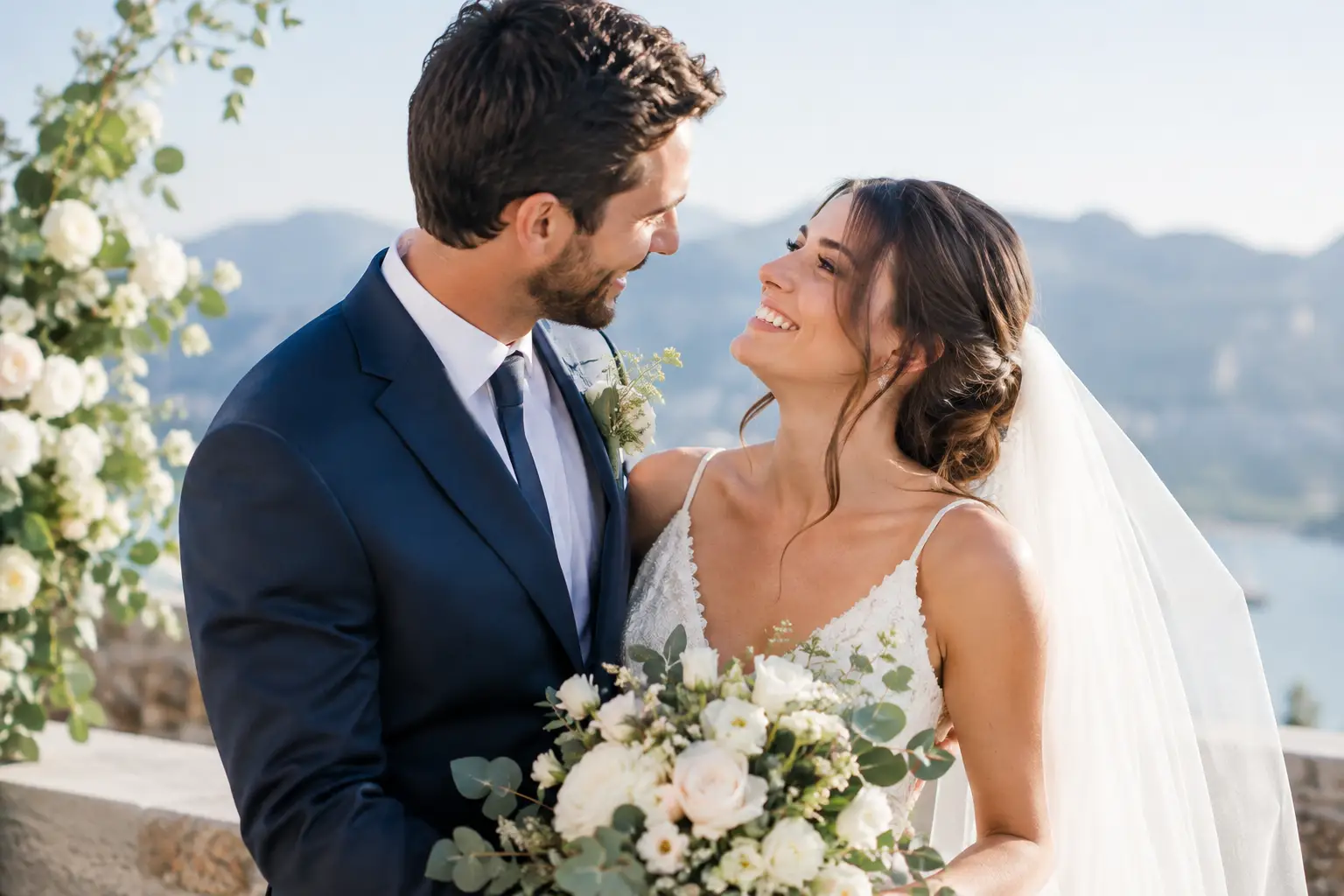
The hand squeeze just before the ceremony. Your dad seeing you ready for the first time. The unexpected burst of laughter during the speeches. These are the moments that give real wedding stories their weight. They are rarely planned, and they cannot be recreated in quite the same way. Years from now, they are often the photographs that take you straight back to how the day felt.
A wedding is full of beautiful details: carefully chosen flowers, a favourite fragrance, the place settings you spent weeks deciding on. Those details deserve to be photographed. But the true heart of the day is in the people around you and the connections between them. It is in the glances you might miss while you are busy living it.
What makes real wedding stories so memorable?
A meaningful wedding gallery is not simply a record of who attended and what happened. It has a rhythm. It begins with anticipation, moves through the emotion of the ceremony, gathers pace with hugs and celebrations, then softens into the quieter moments in between.
That story might include your partner taking a steadying breath outside the ceremony room, a bridesmaid repairing a buttonhole with impressive concentration, or a grandparent watching the dance floor fill up. None of these moments need directing. In fact, directing them would take away the very thing that makes them matter.
The best photographs make room for the personality of the day. A formal city celebration in Edinburgh will have a different energy from a windswept gathering in the Scottish Borders or a relaxed Northumberland barn wedding. Neither is better. What matters is that the photographs feel true to you, rather than copied from somebody else’s mood board.
The photographs you do not know to ask for
Most couples naturally think about the aisle walk, the confetti, family photographs and the first dance. These are important parts of the story, and an experienced photographer will make sure they are covered with care.
Yet many of the most treasured images happen around the edges. Your mum straightening your collar. Friends sharing a joke during the drinks reception. Little ones falling asleep after giving everything to the dance floor. The look on your face when your favourite people begin cheering during a speech.
These unscripted moments are why a photographer needs to be observant as well as technically confident. There is no second chance for a fleeting expression or a spontaneous embrace. Being present without becoming the centre of attention allows those moments to unfold naturally.
Real wedding stories need trust, not perfect posing
Few people feel entirely comfortable when a camera first appears. That is completely normal. You do not need to be a model, know what to do with your hands, or spend your wedding day performing for photographs.
The aim is to create enough calm that you can forget about the camera for long stretches of the day. A little gentle guidance can be helpful, especially for a short couple portrait session or family group photographs. But it should never leave you feeling as though you have disappeared from your own celebration.
There is a balance to strike. Leave everything to chance and you may not have the relaxed portrait of the two of you that becomes a favourite print. Over-plan every image and the day can begin to feel like a photoshoot with a wedding attached. A thoughtful approach protects time for both: a few well-organised moments for the photographs you will want on the wall, and plenty of freedom for the real ones to happen.
At Graeme Webb Photography, that balance is at the centre of the experience. The goal is not to manufacture emotion, but to give you clear, reassuring direction when it helps and space when it does not.
Why the quiet moments matter just as much
Wedding photographs are often associated with big emotion, and rightly so. Tears at the ceremony and laughter during speeches can be wonderful to revisit. But quieter frames can carry just as much feeling.
Think of the two of you stepping outside for five minutes together. Perhaps the light is fading over the venue grounds, or there is a break in the Scottish weather that gives you a breath of fresh air. There may be no dramatic pose involved. You simply get a small pause to take it all in.
Those portraits can become particularly meaningful because they hold a feeling that is easy to forget amid the happy blur: the fact that, for a moment, you were together, newly married, and surrounded by everyone you love.
Telling the story without getting in the way
Natural wedding photography is not about standing at the back and hoping for the best. It takes preparation, judgement and an understanding of people. Knowing when to step forward, when to wait, and when to quietly move around a room makes a real difference to the finished collection.
Before the wedding, it helps to talk through what matters most to you. Perhaps your family has travelled a long way and group photographs are especially important. Perhaps you are having a small ceremony and want the focus firmly on candid moments. Perhaps there are people or relationships you would particularly love to see documented.
Sharing this does not turn the day into a rigid shot list. It gives your photographer context. It means they know why your sister’s reaction during the ceremony matters, why a certain heirloom should be noticed, or why a photograph with an elderly relative deserves a little more time.
Good planning also makes the practical parts feel less intrusive. Family photographs can be warm and efficient when there is a sensible list, a little time set aside and someone who can help gather people. That leaves you free to get back to your guests instead of spending an hour wondering where Uncle John has gone.
From a wedding day to a family heirloom
A digital gallery is a wonderful way to revisit a day. You can share it with loved ones, enjoy it on a quiet evening and relive moments you did not see at the time. But photographs have a different presence when they are printed.
An album lets the story unfold in sequence, from the nervous preparations to the final dancing. A framed photograph in your home becomes part of everyday life rather than something waiting behind a password. Over time, it gathers meaning. One day, it may be a picture your children or grandchildren ask about.
That is why it is worth thinking beyond a handful of highlight images. The enormous smile, the tears and the joyful chaos all belong there, but so do the in-between frames. A hand resting on a shoulder. The curve of a bouquet on a table. The way your friends look at you when you are not looking at them.
Let your day be your day
The pressure to create a picture-perfect wedding can be surprisingly loud. Social media makes it easy to feel that every table, pose and timeline must look a certain way. But the celebrations people remember most fondly tend to be the ones that feel personal, even when a plan changes or the weather does not cooperate.
If rain arrives, it may mean umbrellas, close embraces and photographs with a little more atmosphere. If a speech runs long because everyone is laughing, that is not a failure in the schedule. If your flower girl refuses to walk down the aisle, it may become one of the stories repeated for years.
Your photographs should leave room for all of that: the polish, the nerves, the love and the wonderful imperfections. Choose the things that matter to you, trust the people supporting you, and give yourselves permission to be fully present. The most lasting wedding photographs are not proof that everything went exactly to plan. They are proof that it was yours.